

Here's an article that I saw just after I mailed my original late this morning.
The Economist on time zones. Russia has 11 and China has only one.
How politics shapes the world’s time zones | The Economist
Blessings,
John
The Daylight Savings Time Kerfuffle Perspective # 76 John Teevan April 1, 2025
I wanted to write an April Fools essay on the endless topic of Daylight Savings Time. However, I cannot bring myself to chide those who oppose DST for no better reason than the difficulty of changing the clocks.
There are two sober and serious issues with our current time zones. First, there is such a thing as a ‘natural time zone’ and our ‘official time zones’ are not always well matched. Some places are more than a half hour from 'true noon'. The other issue is that days get much longer in summer (or shorter in winter) in the North than in the South. This is a new idea so be patient.
The longest day of the summer is 13:40 hours in Key West and 16:10 hours way north in Bellingham, WA. That is a 2.5-hour difference of the longest day of summer. In the winter there is another 2.5 hours of difference making, on those extreme days a total of five hours variation in daylight between the South and the North. If there is a problem with not being in the 'natural' time zone, it is minimized in the southern states and maximized in the northern states.
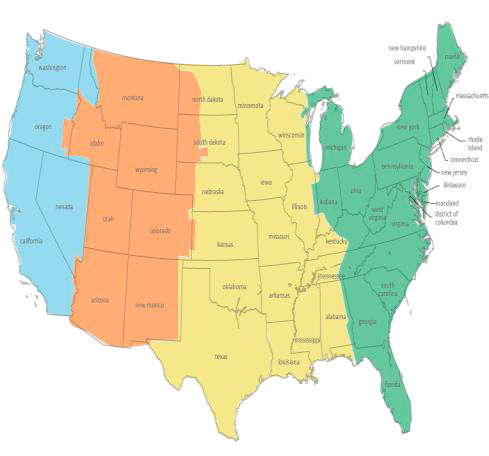
Here are two maps that you have been looking at. The top one shows our current time zones with three north south lines showing where the borders of the natural time zones lie. When it is high noon in Greenwich in England at zero degrees longitude it is 'true noon' at noon. Every 15 degrees going west we find another 'true noon'. in the U.S.: 75˚(Phila), 90˚(Peoria IL), 105˚(Denver), and 120˚(Reno) west of Greenwich. Clear?
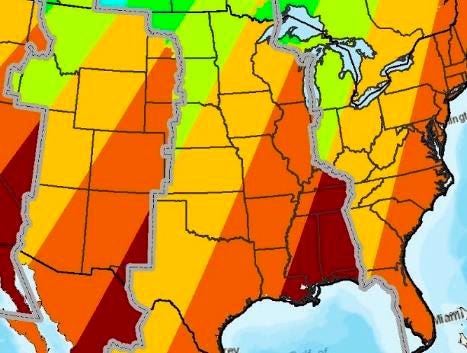
Indiana and Michigan: On the top map, the West and Mountain time zones are nearly accurate. The Central time zone has a tier of states above Texas that might be moved to Mountain time. The surprise, and the largest impact on people, is found in the current border between the Eastern and Central time zones. Georgia along with Indiana and Michigan and half of Ohio lie in the natural Central time zone.
Remember that the impact of time zones is less in the south and greater in the north. We should not be surprised to find that the greatest deviation between natural time zones and our current time zones is felt in Michigan and Indiana. The light green area of the lower map shows where the deviation is the most extreme.
Michigan and Indiana (and the other light green areas) are far enough north to have exceptionally late sunrises (6:15a EDT here in Winona Lake in the summer and 8:15a EST in the winter). We also have exceptionally late sunsets (9:15p EDT in the summer and 5:15p EST in the winter. (Based on NOAA Sunrise Sunset Calculator)
Some children in this green zone board the school bus for up to 1.5 hours before sunrise in the winter. The green zones are of no interest to urban America, but the 17m people who live in MI and IN notice, and these are the states where the occasional tragic 'O Dark Thirty' school bus accidental deaths occur. This is serious.
A poor solution would move IN and MI to the Central time zone. Some want no daylight savings time at all. If both changes were to take place summer sunsets here in WL would shift from 9:15p EDT to 8:15p CDT but would further shift to 7:15p CST if DST were ended. Ouch! Winter sunrises shift from 8:15a EST to 7:15a CST.
A simpler solution would be to change the dates when DST begins and ends. Moving spring DST to mid-April from early March (and to mid-October in the fall) would bring more daylight to early mornings when it can help the most. During that time of year, the sunrises change about two minutes daily. Waiting 30 days would provide about an hour more daylight in the mornings. Time zones are both very simple and totally confusing.
Today may be April 1, but I cannot scold us for our confusion about DST. I used to work at the Michigan City prison where time morphed from being the same as Winona Lake to being different twice yearly.
If changing clocks is difficult then maybe the U.S. should use just one time zone. April Fools! If resetting clocks is so difficult, maybe we should limit travel anywhere involving six or more hours of time change. We could insist on a two-day layover in Iceland or Hawaii before making the awkward journey to Europe or Asia. April Fools! You see why I decided against such humor.