

One of the most useful and insightful stories of philosophy comes from Plato, who gave us his cave illustration. Everyone in the West, except North Americans, is familiar with Plato’s cave. It helps us think about life, reality, knowledge, and even meaning. I’ve shown the Claymation version to my class for years. Deep inside a large cave, prisoners are chained to a wall. The wall in front of them is all they can see. On that wall they see shadows cast from animals and people carrying many different things walking behind them on a raised walkway. Behind that walkway is an unseen fire casting the shadows. The shadows and their fellow prisoners are the only reality the prisoners know.
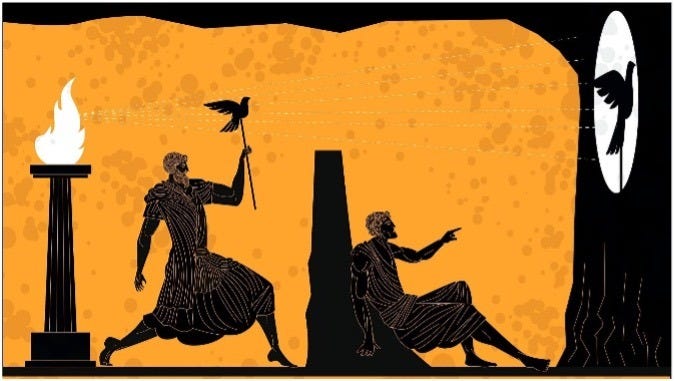
One day, a prisoner is released and can see the walkway and the fire, but even better, he’s led to the mouth of the cave and out into the blazing sunlight. If he was amazed by the animals and people on the walkway, he was actually stunned by the vastness of the world outside the cave. He began to thrive in that world and then realized he should go back in to tell his fellow prisoners. Sadly, as he called from the walkway, he appeared as a shadow, and what little they heard made them think he had lost his mind. They refused to believe that there could be anything beyond the shadows. That may be their honest opinion, but it does not make the outside world any less real.
Plato wanted us to trust the philosophers who have become unchained from the shadowy reality of ordinary life. Besides, philosophers are no longer ignorant about the reality of the shadow-casters and the vastness of the larger world. Ignorance must be abolished. Reason can do it. That is enough. (Plato Republic Book VII).
Do we live in a world of shadows? Students say that the screens we live by, the images of movies and digital dystopias suggested by The Matrix, and even the image of ourselves we cultivate to impress others, are such shadows today. Are we also resistant to reports about a better reality? Yes, that resistance is what chains us. Is there a more robust world? Yes, the shadows we see are cast by a more robust reality, and the outside world is fully amazing. Plato suggested two kinds of people: those who limit reality to the shadows are one kind. Those who see beyond and outside are another. People can escape. Amazingly, today some seem to prefer or return to chains.
As students have discussed this, they note that the prisoners chained in a world of shadows cannot hold on to their humanity, even though they talk to each other. Anyone who escaped feels sorrow for those prisoners. Their ignorance is a worse chain than physical ones. Why? Because they are missing out on true life.
As philosophy progressed over the centuries, Descartes taught (roughly) that external reality was unnecessary, as reason alone could imagine the walkway. Reason is sufficient for living. Then the empiricists like Locke and Hume said that reality was not only limited to shadows, but that we should not hope for more. It is as though they, and many others after them, failed to benefit from escaping.
Immanuel Kant (1800) taught that we prisoners could imagine more and could believe in the outer world, but only on a false or ‘as if it’s real’ basis. Jean Paul Sartre, in his 1950’s Parisian café, thought them all absurd. He wrote books that sounded like what prisoners in a cave might write: Nausea described their life, and No Exit described the hopeless illusions of thinking there was a path to an outside world. Yet the church father, Augustine, agreed that we are trapped in illusions of an incomplete and inadequate world but he wanted a better explanation.
Christians have a cave…an empty burial cave. Unlike the modifications over the centuries that would paint Jesus and all that’s biblical as nothing more than inexplicable shadows, Augustine, in his Confessions (400 AD Books X-XII), deliberately corrected Plato’s idea that reason alone was sufficient. Lostness in shadows and illusion requires more than reason. Plato’s ascent to the ‘good’ through reason for the benefit of the ignorant was insufficient compared to the ascent of sinners who are deliberately rescued by the resurrected Jesus through grace to God (R.H. Craig). The problem is not ‘chains’ of ignorance but our deep inabilities, our true moral and spiritual failings.
Plato’s prisoner was simply ‘released,’ apparently through his own awakening to reason. The Christian cave is empty because Jesus did not just come as a teacher to show the way, but as a savior to rescue us to new life.
While Plato’s cave story is a wonder, it was the life and resurrection of Jesus that transformed humanity, making Plato’s excellent story fall short of Jesus’s truly transformative life and message. Didn’t Paul the Pharisee (Acts 9) and possibly existentialist Jean Paul Sartre (Metaxas, Is Atheism Dead? Ch 21) become believers in Jesus Christ?